Showing posts with label Architecture. Show all posts

Sunday, August 10, 2008

NBM

Building Museum 8-9-08

There's been an exhibit at the National Building Museum for the past few months that I've been meaning to see: Eero Saarinen: Shaping the Future.  I finally went yesterday, ready to take a number of pictures - Chris has said he is a fan of Saarinen's work, and urged me to go to see this.

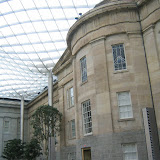
Unfortunately, photography was not allowed.  I did take some pictures of the NBM, which is one of my favorite buildings in DC.  It was originally built as the Pension Office after the Civil War, so the stairs have long, easy grades for injured veterans.  The atrium is pretty amazing - they use if for kids paper airplane contests.

The Saarinen exhibit was extremely interesting.  They had a number of detail design drawings for some of his buildings, like the Yale Whale, Gateway Arch, and TWA Terminal.  Saarinen was also did a lot of furniture design, and they had examples of some of his more successful works.  Too bad they were displays, and you couldn't sit in them; the Womb Chair looked very comfortable.  I was intrigued by the "criticism" leveled at Saarinen by his contemporaries, that he "invented a new style for each project."  I think that is an obvious virtue - not letting any kind of dogma or standard practice inform a design, but creating the right solution for the problem.  If that's the way Saarinen worked, then I'm a fan of Saarinen.

Saturday, February 09, 2008

Doctor of Fine Arts

SAAM 2-9-08
I had some free time today, and decided to make the most of it and take a quick jaunt into the district. I went to one of my favorite museums, the combined Smithsonian American Art Museum and National Portrait Gallery.

They've completed the courtyard renovations since the last time I visited. It is a great public space - comfortable, lots of activity without being overly crowded. The two signature elements are the undulating glass canopy and the shallow pools. The pools are merely sheets of water, and are constantly in motion - pumped in on one end, flowing down a barely perceptible slope into a drain. Since it is barely a puddle, kids run through them constantly. It livens the place up quite a bit.

The entire museum has good exhibits, but the most popular single work today was the recently installed portrait (or is it portraits?) of Stephen Colbert. It is just outside the Hall of Presidents... in the antechamber of the restrooms. There's a photo in the album linked above. I walked by a few times, and there were never less than a dozen people crowding around for photos.

Thursday, December 06, 2007

Bookshop

I've explained my love of libraries before, but truth be told I may like bookstores even more. I can't explain it any more than to say that while a library is fairly static, a bookstore is dynamic. Books flow through a bookstore, while they are archived in a library. I'm fond of both, but since I want to possess the books for myself, a bookshop might have a slight edge for me.

Having said that, there are good bookstores and bad. Having worked at a Barnes & Noble, I can tell you that many of them are not what I would call good bookstores. Books-a-Million is an awful, awful place. But some Borders are pretty good.

Independents are a gamble. It's where you will find the best bookstores, and the worst. The bad would be places like the used bookstore off of the main drag in Blacksburg, which had little beyond water-stained pulp novels. The good are places like Northshire Books, the local Olsson's chain around DC, and once upon a time, the bookstore my mom helped found, Deerleap Books.

The heart of a good bookstore is the selection. It doesn't have to be broad - you don't always want a warehouse. Just books chosen carefully, recommendations from an intelligent and well-read staff. Of course, it doesn't hurt if you have a nice place to put it all.

Few bookstores approach the aesthetic beauty of the great libraries like the British or the Library of Congress. But to finally come to a point, I just read about one that does. It is in Maastricht, the Netherlands, and is housed in converted church.


(It won an interior design award. To see more photos and information, read here and here)

It doesn't look cozy, but I think it would be a marvelous place to spend a few hours and pick up a few volumes. But only real classics of capital "L" Literature or great works of non-fiction. Buying the latest Oprah book here would seem wrong, somehow.

Thursday, June 28, 2007

Valley (of the Kings) Girl

Interesting news out of Egypt this week. Archaeologists from that august institution, The Discovery Channel, have found the long-lost mummy of Queen Hatshepsut, one of the few female Pharoahs. It is particularly interesting, because one of the the finest buildings of antiquity is her mortuary temple Djeser-Djeseru at Deir el-Bahri (seen to the right, photo courtesy Wikipedia), where her body isn't buried.

I'm a sucker for the old tales of Howard Carter stumbling into the tomb of Tutankhamen, and the misdirection angle makes this even more intriguing. There is evidence that Hatshepsut's stepson, Thutmose III, attempted to destroy all records of her, including removing statues from her temple, deleting her from official histories, even chipping her images out of hieroglyphics. Blended families are challenging, even when you are a God-King.

Regardless, it is a fascinating discovery. And the location the mummy was found may shed some evidence on the presumed actions of Thutmose III. It also gives me an excuse to put up a picture of Djeser-Djeseru, one of my favorite buildings. A grand stepped series of colonnades, set into the side of a stark sandstone cliff. Very cool.

Tuesday, June 26, 2007

Expertise

I like to think I know a little bit about some things. I'm not an expert about much of anything, just enough to be dangerous. But one of my chief pleasures is learning more, especially from people who are experts. And it is doubly enjoyable when they are passionate about the subject.

I bring this up because I recently had three very enjoyable conversations along these lines. The first was part of my ongoing rowing education courtesy Steph, Aaron, and Sarah. Aaron and Steph have explained technique and the various positions in the boat (stroke, "engine room," etc). Sarah has been teaching me about how they start, training methods, and coxing (which she did for the first time recently). I'm not a rower and don't imagine I'll ever find myself in a shell, but they make it interesting. Probably because all three of them clearly love rowing.

This past weekend, Chris was visiting while he was at a professional conference. He gave me a copy of the most recent Architectural Record. It had very interesting articles and gorgeous photos of the church of Saint-Pierre de Firminy by Le Corbusier, the refurbishment of Griffith Observatory, and other significant buildings. But what really got Chris going was the bit about the opening of Glass House. I'm not fluent in the design arts, so he had to teach my why Glass House was just an inferior rip-off of Mies Van der Rohe's Farnsworth House. In Chris's opinion, Farnsworth is "otherworldly" and a consistent expression of Van der Rohe's ideology and architectural ideals, while Glass House is the unwieldy marriage of the otherworldliness of Van der Rohe and the site-specificity and engagement of a Frank Lloyd Wright design. It was very cool to hear him hold forth.

And yesterday, I skipped out of work to have lunch with Sarah and Heidi, who is in town for a few days. She talked at length about her trip to China, how to find work in the pastry and 4-Star restaurant businesses, and Alexander Hamilton. I've always found Heidi to be much more culturally literate than myself, more traveled and with excellent taste. So I pay attention and try to pick up a few things. We talked about her visit to the National Portrait Gallery, and then about Hamilton. This was a bit more in my wheelhouse, but she just finished the latest big biography on him, and taught me a few things. So now I'm looking forward to getting that off my "to-read" shelf soon.

I am interested in all of these topics, in of themselves. But even more, I am interested in these people, and that includes their hobbies, interests, and passions. So I really enjoyed all of these conversations. They remind me how broad the world is.

Tuesday, March 27, 2007

Corridor


I've written about this before, but it is still striking. I had occasion to take a walk down M Street today, going to the Navy Yard. This was the exact same walk I once took daily 6 summers ago, when I was an intern at NAVSEA. I've remarked before on how much this part of DC has changed. Once, it was nothing but abandoned row houses, muffler shops, and empty lots. But since NAVSEA moved in, office towers have been springing up. There's a hotel and condos now. An excellent website, Near Southeast, catalogs these developments.

Probably most symbolic of the changes is the new ballpark. I can see it going up from my office window. Just last week, a new portion of the upper deck blocked off my view of Coast Guard Headquarters forever. There is a lot of talk of how the stadium will anchor development, a "ballpark village." I'm not so sure - I think it will be fairly lively... 81 days a year. Down the street, the Nationals' owner is putting up an office tower, which is where the webcamera that took the above picture is installed. On the roof, the national ensign is flanked by the District flag and a banner bearing the curled W of the Nationals. It is distracting - right outside my window, flapping in the breeze, reminding me that baseball season is so close.

I think that office tower, and all the others like it, will have more impact on the neighborhood. Probably the biggest change to the area, after NAVSEA, is the new Department of Transportation Headquarters. Seven thousand people are moving in soon, and they will be here 5 days a week. That means more food services, more traffic, crowded Metro trains, more everything. The District is creating a second downtown.

Washington is surrounded by the infamous Beltway, but it is divided by the less well known Southeast Expressway. This highway runs from the old Long Bridge Potomac crossing near the Pentagon, then east across the city, just south of Capital Hill, terminating at Pennsylvania Avenue where it crosses the Anacostia. Almost the entireity of SE and SW Washington are walled off from the rest of the city by a raised expressway, similar to the erstwhile Central Artery in Boston. The central business district of the District is K Street. But for a number of reasons, another is slowly growing here in Southeast. In a few years, everything that exists in Downtown will exist here on M Street SE, in miniature. Numerous office and condominium high-rises, cultural centers, major federal headquarters, etc. It is a novel experience, watching as a new neighborhood is created, essentially from whole cloth.

I have to wonder if there is a better way, though. Not that there is anything glaringly wrong with the new Southeast, or even the existing Downtown. But it is being done in a fairly piecemeal fashion, each owner developing their plot as they see fit. Though I don't necessarily think a centrally plan would be any better, a scheme, a guide, an aesthetic, might be helpful. DC is more than just its monumental core. In addition to it's massive public spaces and institutions, it must have all the parts of a modern, working city. But with so much space given over to government facilities, the Mall, Rock Creek Park, the Smithsonian (all on prime, central real estate), and prohibited from building skywards, the city must be especially efficient with its design and use of space. Otherwise, more people will move out to Rockville and Manassas, and work in Bethesda or Tyson's Corner. The challenge is to grow as a livable, working city without losing the character that makes Washington completely unique. And with its heightened pace of change, the M Street Corridor exemplifies that struggle. I think it would be wise for citizens of other growing cities to watch what happens in DC very carefully.

If Washingtonians want to look for an example to follow, I don't think they need look much farther than across the river. Arlington has been very successful in creating a core around the corridor from Rosslyn to Ballston, along the Orange Line. Towers rose near the metro stations, surrounded by restaurants, shops, and services, trailing off into the residential single family homes. I think M street from the Waterfront to the Navy Yard has similar potential, and the District should move now to encourage that, regulating enough to maintain a "sloping" neighborhood from towers to townhouses.

I can't say why I find this interesting - I don't actually live in DC, and once this assignment is over, I won't work here either. But complete makeovers of entire sections of major American cities are unusual events - the only larger recent occurrences I'm aware of are the Big Dig, the reclamation of Stapleton Airport in Denver, and Ground Zero. Each has taken a different approach, so the comparison should be valuable to the next generation of city planners. But its value to me, and most readers, will be as an intellectual exercise. How do you redesign a city?

Thursday, March 08, 2007

It's a Celebration

Slate recently had a very interesting piece on the planned town of Seaside, Florida. If you saw The Truman Show, you've seen Seaside - most of the movie was filmed there. I've never been to the town, so I my opinions are only based on photos and the descriptions of others. But I have a somewhat mixed reaction. I like how it looks, I like the plan to make a walkable town, the attempt to roll back the trend of building around automobiles. On the other hand, it's only made possible by very strong regulation, controlling what owners can and can't do with their property. The libertarian in me intensely dislikes that aspect.

Seaside, and other planned towns like it, such as Celebration, help frame larger questions. What kind of towns do we want to live in? Is New Urbanism really nostalgia dressed up as a movement? Free market thinking would indicate that the kind of towns people really want are suburbs designed around automobiles. Or is that putting the cart before the horse - is that what everyone is buying because that is the only thing available?

But more interesting to me is the more central question of design. How do we decide what is best in design? In my work, in engineering, this is often a very straightforward question: the ship must meet certain specifications for speed, strength, mission capability, etc. But once those criteria are met, the process becomes much more gray. Is it better if the messroom is forward off the galley, or starboard of it? Questions of arrangements, especially, fall into this category. The challenge is more akin to architecture, and city design. And very few engineers are equal to the task. I know I'm not. Luckily, not my job right now.

The challenges of design impact my city, my neighborhood, quite directly. Many in DC are now questioning the height limit. Unique among modern American cityscapes, Washington hugs the ground, and the skyline is punctuated by a handful of significant buildings - the Capitol, the Washington Monument, the Cathedral. I am a big fan of the height limit - it makes DC unique and special. Seeing the Cathedral in the distance from the Metro bridge still amazes me. Others argue that the height limit stunts the growth of the city, and encourages sprawl. But I've also heard about low tenancy rates at many office buildings, and a quick look at sites like Near Southeast show more space is coming. I say keep infilling around existing Metro stations, right up to the height limit, then worry about sprawl.

Closer to home, the Potomac Yard development is going up just a few blocks from my house. The renewal of the the largest undeveloped urban tract on the east coast is at least attempting progressive design. It's not a pocket suburb of cul-de-sacs and curving lanes - it is set up as almost a city-in-miniature, with a downtown commercial area surrounded by a grid of residential streets. As I said above, I'm not sure if I'm necessarily a fan of new urbanism style designs like this, but it is definitely better than another strip mall fronted by massive parking lots. And there is a chance it could lead to an infill Metro station closer to my place. In about 10 years...

So, what kind of place do we want to live? Distant suburbs and exurbs, with plenty of space for yards and garages and playgrounds? Dense urban centers, served by mass transit and only footsteps away from the full range of services and cultural activities? Do you want to own property in the boonies where you can do whatever you want with your land, or live in a condo with a million rules but right next to the Kennedy Center? I say give Burlington, Vermont some thought. Recently cited as the "Best Green Place" in the country, among it's other accolades, it's a fine town. Big enough, but not so big it suffers for it. But don't move there - too many people would ruin it. Go find someplace else like it, though.

Beyond cities and homes, what makes for good design? Is pragmatism the only yardstick, or should we give weight to aesthetics? But if "form follows function," isn't extra credit for aesthetics immaterial, since if it works well, good form will naturally follow? Then we just need to define function. It's easy to decide if a stapler works: it staples or it doesn't. How do you measure measure the functionality of a house? A city? Is a pleasing aesthetic part of the core function of a city? I think so, but taste varies so much, the city might "function" for some and not for others. I think you are starting to see why I'm an engineer, with more straightforward design questions, rather than an architect like Chris.

Sunday, August 27, 2006

Paintings, Scupture, Music, Buildings

I hit the culture trifecta today.

First thing, I got outside before it got too hot and muggy and cleaned up the yard; mowing, weed-whacking, etc. I had been letting some of the fast-growing "weeds" along the fence to grow all summer. One was so big, it was like some Pleistocene-era tree. I had to cut it down with the saw on my Leatherman. Fun.

While I finished up mowing, Steph & Aaron called and invited me to join them for brunch at Fireflies. It was excellent, and they had some excellent stories from some of their recent hijinx. They have almost perfected the tandem-storytelling technique that so many couples use. Keep practicing, kids. If you know them, ask about Aaron and the forks, and Steph's concussion.
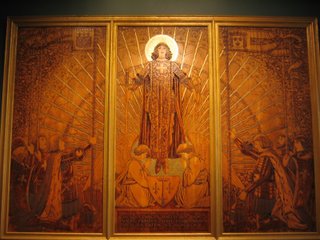
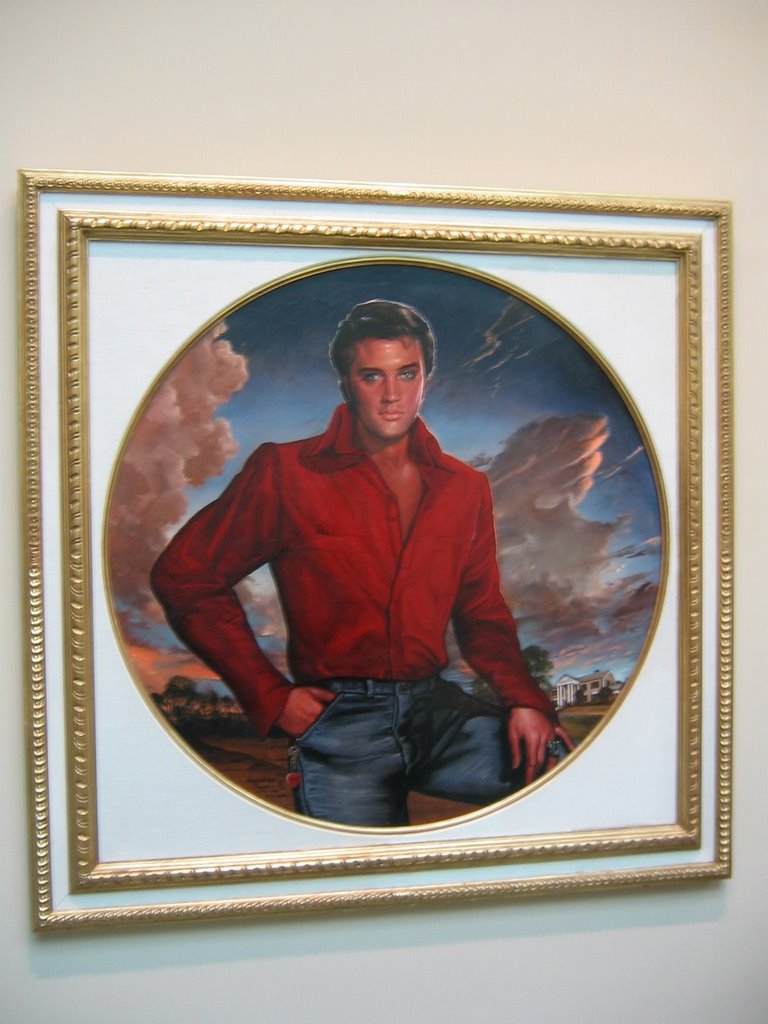
After brunch, I finished my laundry and Metroed into D.C. to visit the Smithsonian American Art Museum and the National Portrait Gallery. I spent about 2 hours in the museums, mostly in the Modernist and Contemporary sections, my personal favorite styles. I took many pictures, but since flash photography is not allowed, many of the pictures came out bit blurry - I think the 'exposure' time must be longer. Regardless, I got some shots of some of my favorites, but I urge any and everyone to go see it for themselves - there's a lot more, and these photos don't even do these few pieces justice.
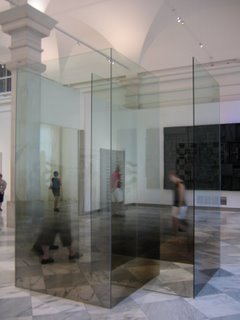
There were a few pieces that I especially liked. The Adoration of Saint Joan of Arc by William Fosdick is really something; it's made of fire-etched wood, and is quite striking. Carved in the bottom in French is "My last wishes, my last thoughts, are for my God, my Country, and my King." In the modern gallery, Untitled by Larry Bell is made of panels of smoked glass; it changes appearance from every angle, going from reflective to transparent and back again. Megatron Matrix is a media installation by Nam June Paik, made of grid of monitors and speakers playing old rock music, with images of flags, Olympic Sports, news telecasts, and raster graphics of ducks. It's insane, and hypnotic. Bird in Space by Liz Lerner is an amazing piece made of small rope woven together to make a large, 3D web evocative of a bird in flight. I'd have taken a picture, but it's small white line with white walls behind - it barely shows up.

At 3:00, I went into the basement auditorium for a concert by a classical trio associated with the Smithsonian. They play on instruments from the Museum's collection: a recently restored Steinway piano from the 1940's, a violin from Paris made in the 1770's, and a violincello from Milan made in the 1750's. It was a very nice concert, featuring Trio in C Major (Hob. XV: 27) by Joseph Haydn, Trio in E-flat Major (Op. 70, No. 2) by Ludwig von Beethoven, and Trio in D Minor (Op. 49) by Felix Mendelssohn. I don't have a very good ear for music in general, and classical music especially. I find I like almost all smaller pieces (chamber muic, trios and duets, etc.), but find that larger works (symphonies, operas) are pretty hit-or-miss; some I love, others I can't warm up to.

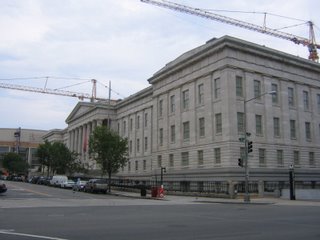
After the concert, I took a short walk outside to quickly photograph the outside of the Museum, which was originally the United States Patent Office. You can still see busts of great, early inventors like Franklin or Fulton in the lobbies. Walt Whitman thought it was the finest looking building in Washington, and it has hosted many Inaugural Balls, including Lincoln's. And right
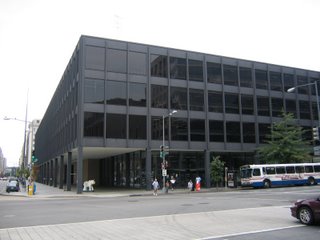
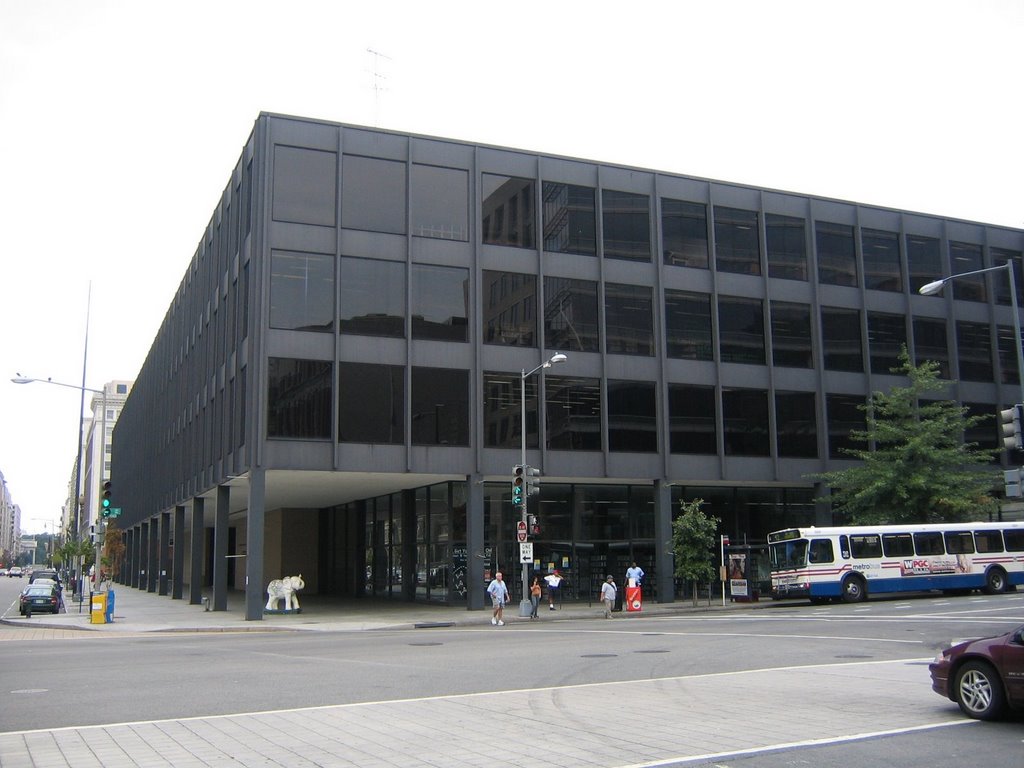
across the street, and only 130 years later, is the Martin Luther King Jr. Central Library, designed by the great architect Mies van der Rohe. The two buildings are very different, but both are masterful.

THE MIND IS NOT A VESSEL TO BE FILLED BUT A FIRE TO BE KINDLED